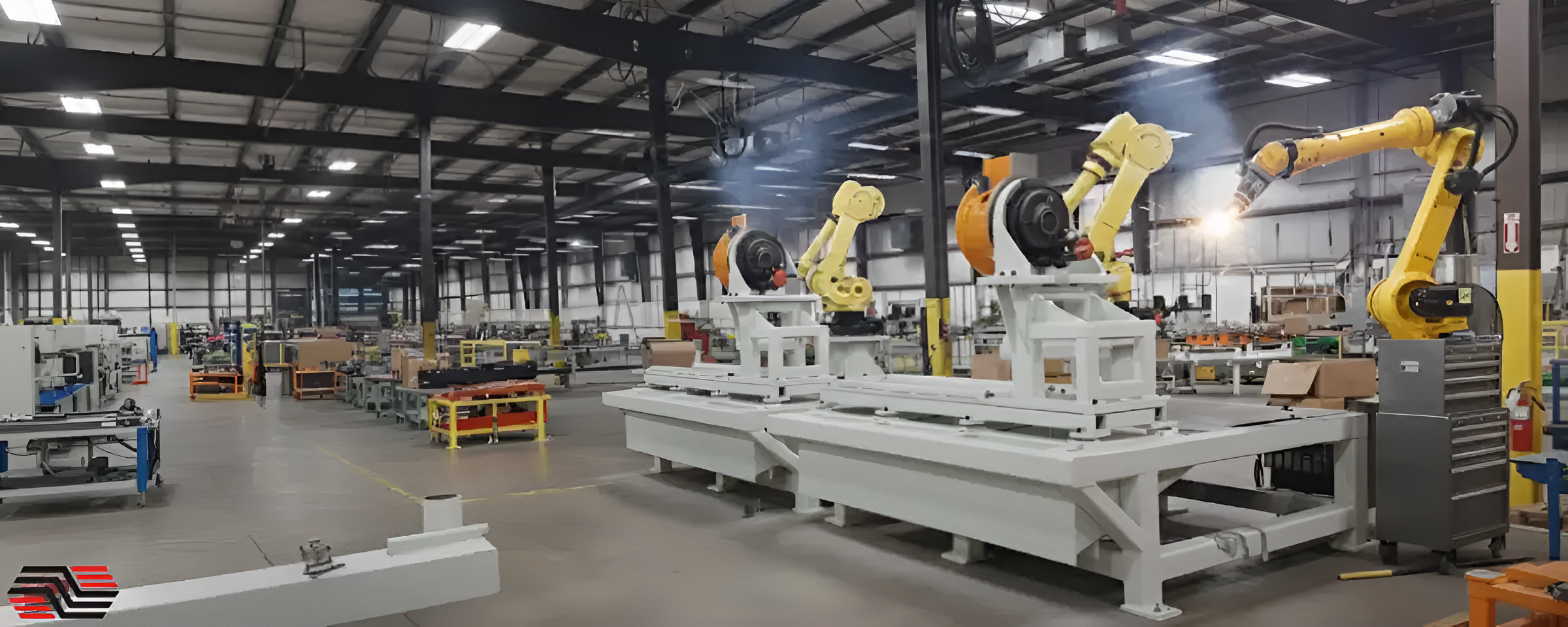
Scaling Manufacturing Is Not a Capacity Problem
Most manufacturers assume scaling is straightforward: add machines, add people, increase output.
In practice, scaling rarely fails due to lack of capacity. It fails because systems that work at low volumes begin to break under higher throughput. Cycle times become inconsistent, bottlenecks emerge between processes, quality starts to drift, and manual interventions creep back in.
What appears to be a capacity gap is almost always a system design problem.
The Real Nature of Scaling
Scaling manufacturing is not about adding more assets. It is about achieving:
- Predictable throughput
- Stable cycle times
- Consistent quality
- Minimal disruption during ramp-up
Where Scaling Breaks
In most environments, systems are not built as unified systems. Machines come from different vendors. Fixtures, automation, and inspection evolve independently. Integration is left to the final stage.
At low volumes, this works. At scale, it fails.
- Interface gaps create delays
- Timing mismatches introduce inefficiencies
- Bottlenecks shift unpredictably
- Accountability becomes fragmented
No one owns performance end to end.
Turnkey Automation: A Different Model
Turnkey automation changes the ownership model.
Instead of delivering components, a single partner owns the entire system:
- Design
- Build
- Integration
- Testing
- Commissioning
The result is a system engineered as one cohesive unit from day one, not a collection of mismatched parts assembled later.
Why Turnkey Enables Scaling
Turnkey systems are built with scale in mind, not retrofitted for it.
- Throughput is designed, not discovered later
- Integration challenges are solved upfront
- System behavior is validated before deployment
- Accountability sits with one partner
The result is predictable performance under real production conditions.
What This Looks Like in Practice
A manufacturer producing multiple door frame variants was operating a manual welding process with three operators per shift handling loading, weld sequencing, and unloading.
The constraints were clear:
- Cycle time could not scale with demand
- Output depended heavily on operator skill
- Weld quality varied across batches
As volumes increased, maintaining throughput without compromising quality became unsustainable.
The requirement was not just automation. It was a system that could deliver consistent output, repeatable quality, and scalable production without increasing manpower.
The System Requirement
What followed was not a simple robot integration.
The system had to:
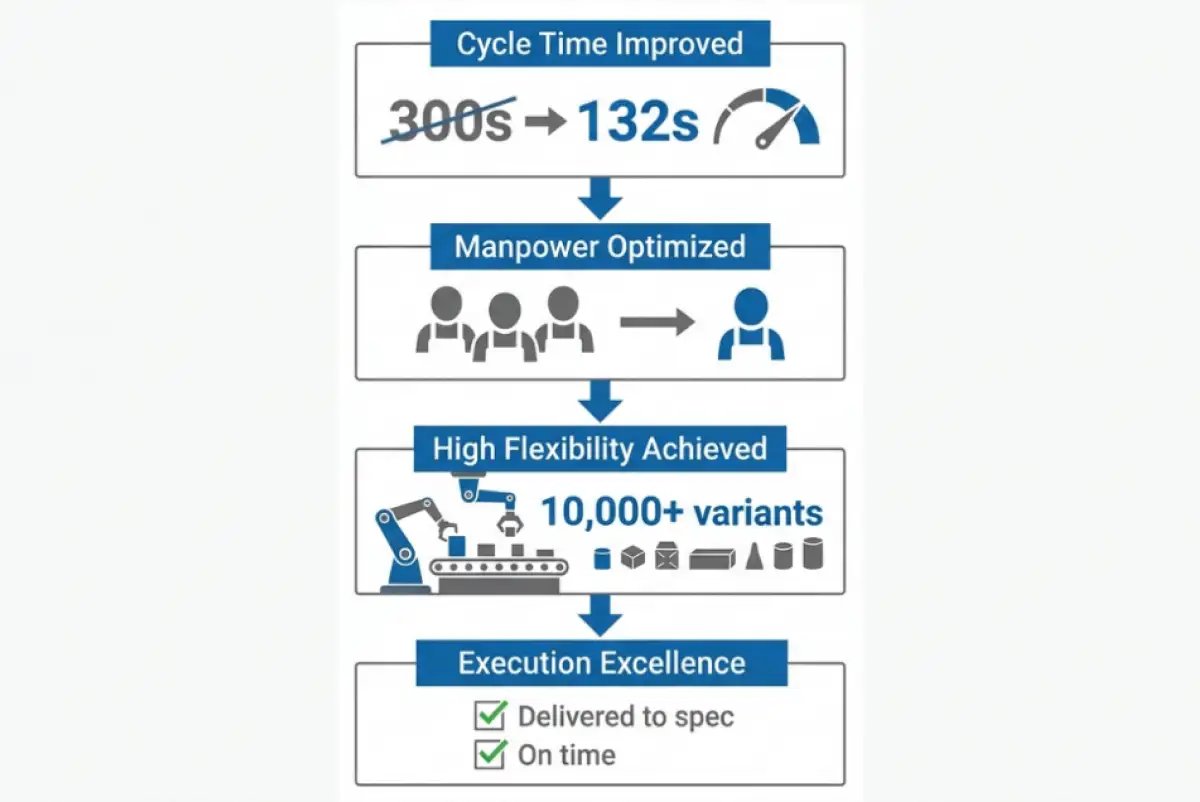
- Handle 1000+ product variant combinations in a single cell
- Achieve a cycle time more than 2× faster than the manual process
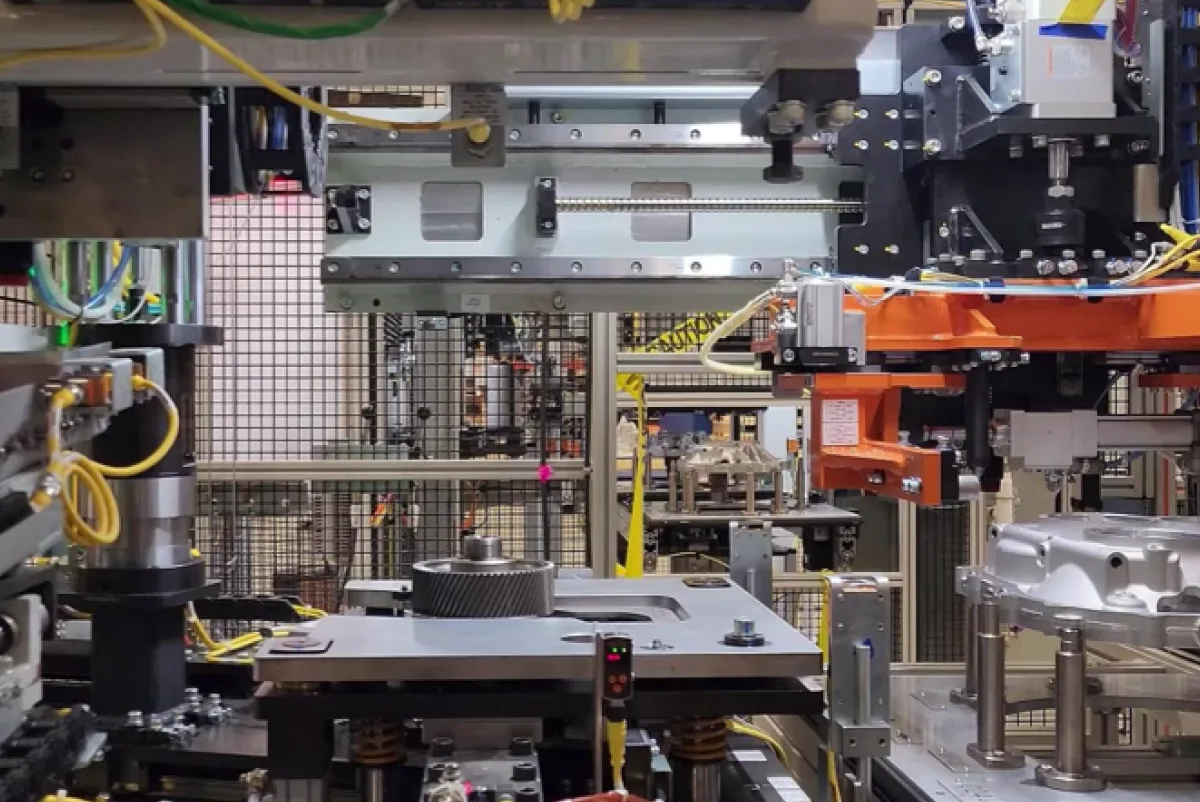
- Integrate a precision 45° grinding operation beyond standard solutions
This required tight coordination between:
- Fixture design
- Robotic welding
- Transfer mechanisms
- Inspection logic
- Grinding operations
Each element had to work in sync. Transfer shuttle timing had to align with robot motion. Inspection feedback had to dynamically influence weld sequencing.
This level of coordination is not achievable when subsystems are developed independently.
With ATS owning the complete scope including design, fabrication, integration, programming, and commissioning, the system was delivered as a fully functional, production-ready solution.
Not a collection of equipment, but a system engineered to perform.
The Outcome That Matters
The real value was not just improved metrics, it was capability transformation.
The manufacturer moved:
- From operator dependent outputto a predictable, high throughput system
- From variable qualityto consistent, repeatable weld performance
- From labour driven scaling limitsto a flexible system capable of handling complexity at scale
This was not incremental improvement. It was a step change in how production could operate.
When Turnkey Makes Strategic Sense
Turnkey automation delivers the highest value when:
- Systems are complex and interdependent
- Cycle times are aggressive
- Product variation is medium to high
- Reliability is critical to business performance
When It May Not Be Necessary
Turnkey may not be required for:
- Simple standalone automation
- Standardized low variation processes
- Environments with strong in house system integration capability
Conclusion
Scaling is not about adding equipment. It is about building systems that perform reliably at higher throughput.
Turnkey automation enables that by ensuring every element is designed, integrated, and validated as one system ready to scale from day one.
About ATS
At ATS, we deliver more than automation. We deliver production systems that achieve measurable outcomes:
- Higher throughput
- Consistent quality
- Reliable performance under real shop floor conditions
Because in the end, scaling is not about what is installed. It is about what performs, every cycle, every shift.