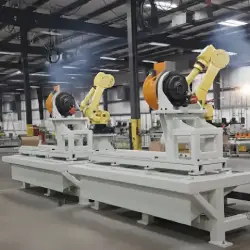
Factory automation is entering a new era. Modern manufacturing is no longer driven only by
machine capacity or production speed. The real challenge today is building production
environments that remain flexible, coordinated, and efficient as product variants, schedules,
and customer expectations continue to evolve.
Working alongside technology partners such as SK Robotics, ATS India.
is
witnessing this shift directly on the shop floor. Manufacturers are moving toward integrated
automation ecosystems
where material movement, robotics, machine connectivity, production monitoring, and workflow
intelligence operate together as one synchronized system. The focus is on designing
automation
that aligns with actual production behavior, ensuring systems remain stable, scalable, and
responsive to changing operational demands.
Moving Beyond Traditional Material Handling
For many years, factories depended on manual transport, fixed routes, and operator-driven
coordination. This approach worked when production was predictable. Today, however,
manufacturing environments change more frequently—product variants increase, machine utilization
fluctuates, and layouts evolve as operations expand. To keep pace, manufacturers need movement
systems that can adapt without disrupting production flow. This is where AGVs and AMRs are
creating meaningful impact.
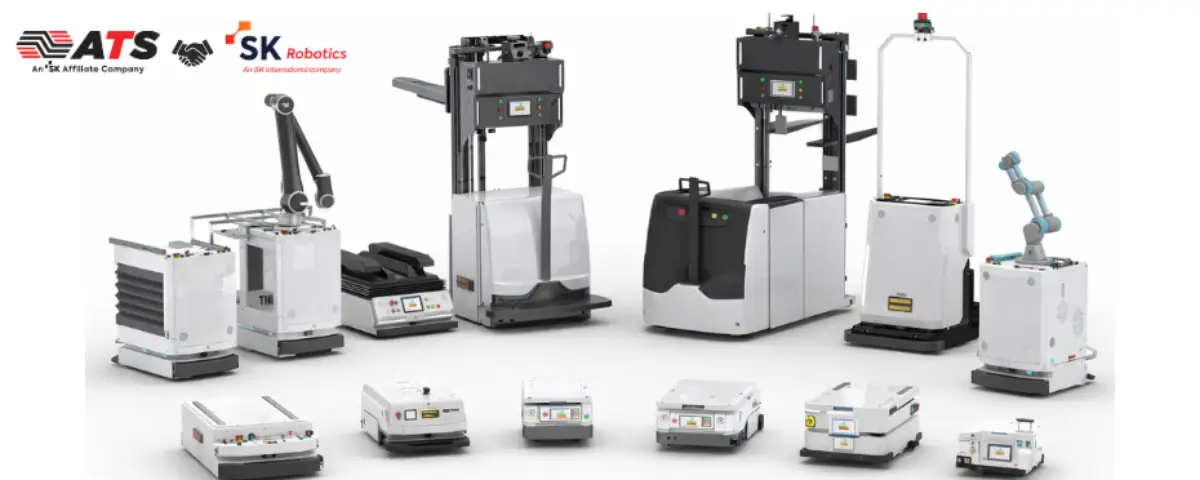
AGVs and AMRs: Precision and Flexibility
Before exploring their roles, it helps to clarify the terminology:
- AGV (Automated Guided Vehicle) follows fixed, predefined paths
- AMR (Autonomous Mobile Robot) navigates freely using sensors
and mapping
AGVs are best suited for operations requiring high repeatability. Their fixed navigation paths
allow them to achieve stopping accuracy in the range of ±5–10 mm, making them ideal for precise
docking, pallet alignment, and integration with conveyors or lifts. In stable, high-volume
environments, they offer predictable cycle times and consistent performance.
AMRs, on the other hand, bring flexibility to shop floors. Using LiDAR, SLAM mapping, and
onboard computing, they navigate autonomously, detect obstacles, and reroute in real time.
Their
natural positioning accuracy is lower than AGVs, but with precision docking modules, they
can
achieve tighter tolerances when required. In many factories, the most effective approach is
a
hybrid one—using AGVs for structured movement and AMRs for areas where conditions change
frequently.
Insights from a Recent Integration Project
During a recent automation project, the objective was to improve material movement between
machining, inspection, and assembly operations. The challenge was not simply transporting
material but coordinating movement across active production zones without interrupting workflow.
A combination of AGVs and AMRs proved to be the most effective solution. AGVs handled fixed,
repeatable routes, while AMRs supported areas where movement needed to adapt to changing
conditions. Collaborative robots and workflow coordination further improved the interaction
between machines, material flow, and operator tasks. The result was a noticeable reduction in
manual dependency, improved visibility of movement, and smoother transitions between operations.
This experience reinforced a key principle: automation performs best when it is engineered to
match real production behavior.
Integration Is the Real Advantage
Adding robots alone does not improve efficiency. Integration does.
Modern factories benefit most when machines, movement systems, inspection, and software operate
as one coordinated ecosystem. Instead of isolated automation islands, the goal is a connected
environment where information and actions flow seamlessly across the shop floor.
ATS builds automation ecosystems where critical functions such as machine-to-machine
communication, AGV/AMR coordination, robotic handling, MES tracking, and production visibility
work together to support continuous, predictable operations. Platforms like
Arc.ops and
Vitra.ai
from Arcstone strengthen this by enabling real-time data gathering, workflow
synchronization,
and intelligent decision-making.
A simple example illustrates the impact. When an AGV delivers material to a machining station,
the MES platform can:
- Check machine readiness
- Trigger robotic or manual handling
- Validate inspection status
- Align movement timing with upstream and downstream processes
This level of coordination reduces waiting time, prevents bottlenecks, and creates a
smoother,
more predictable production flow.
Vision Systems and Robotic Decision Support
As factories become more automated, the need for intelligent inspection and decision-making
increases. Vision systems integrated into production workflows can achieve measurement accuracy
below 0.3 mm, enabling precise dimensional checks, orientation verification, and robotic
guidance. This level of visibility is essential when AGVs, AMRs, cobots, and machines must
coordinate continuously. Vision systems provide the “eyes” for robots, while movement systems
provide the “mobility,” creating a more adaptive and intelligent manufacturing environment.
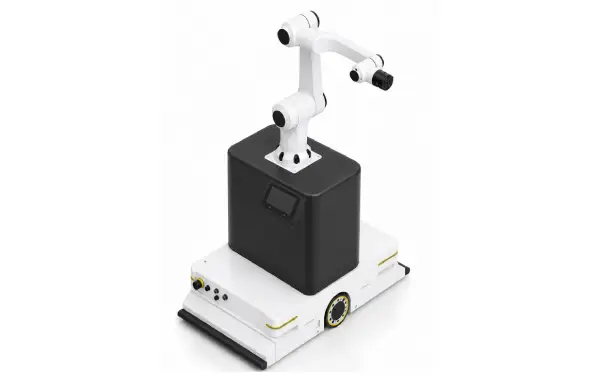
Cobots in Modern Manufacturing
Cobots are becoming a key part of flexible automation. They support:
- Machine tending
- Assembly
- Inspection
- Pick-and-place
- Repetitive handling
When integrated with movement systems, machine connectivity, and MES platforms,
cobots help
create:
- Synchronized workflows
- Consistent handling
- Scalable production environments
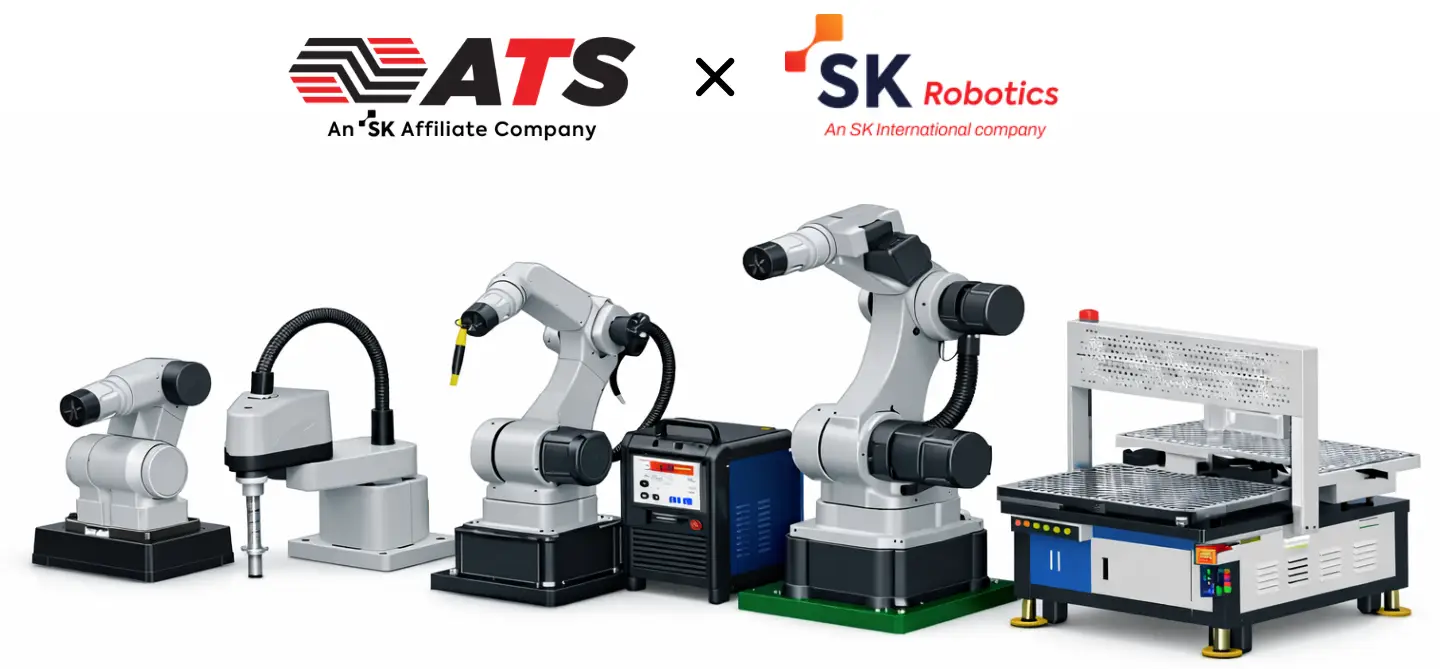
ATS ×
SK Robotics
Collaboration
SK Robotics, together with ATS India, supports manufacturers in deploying smarter and
more
connected automation systems. This collaboration brings together expertise in material
movement,
collaborative robotics, machine connectivity, vision inspection, and workflow
coordination. The
shared goal is to help industries build flexible, scalable, and production-ready
automation
environments suited for modern manufacturing demands.
The ATS Approach to Automation
Automation is approached from a manufacturing-first perspective, ensuring systems perform
reliably under real production conditions. This includes engineering automation systems,
integrating intelligent movement, connecting machines, deploying vision inspection, and
coordinating workflows through software. AGVs, AMRs, cobots, vision systems, and integrated
automation platforms are no longer future concepts—they are already shaping the next phase
of
factory automation.