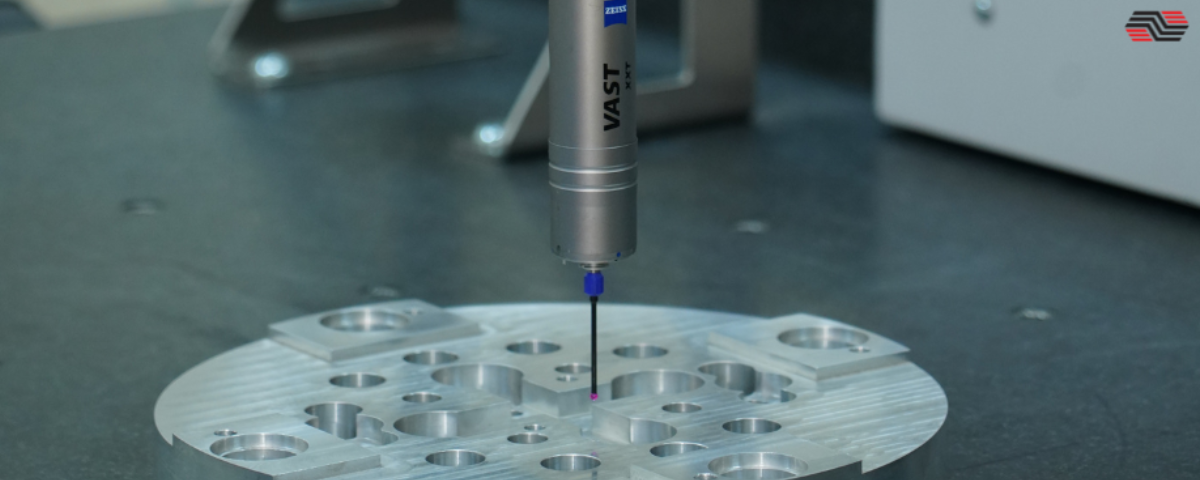
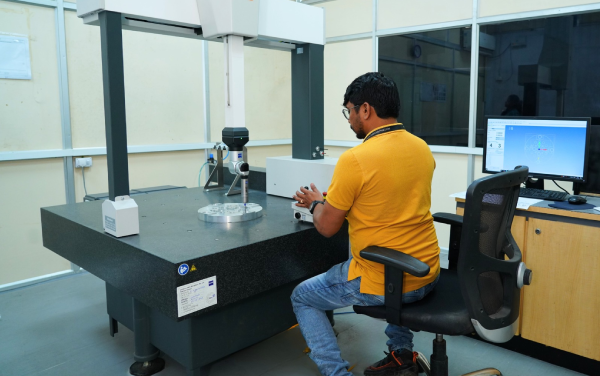
At ATS India, we take measurement and validation seriously, especially when it comes to parts with complex and curved geometries. Standard coordinate measuring systems (CMM) often work well on flat or prismatic parts, but not when the surface flows, blends, or twists in multiple directions.
That’s why we use Curved Surface Measurement Software, designed to deliver exceptional accuracy even on challenging 3D contours.
Understanding Curved Surface Measurement
Curved surfaces are common in aerospace, automotive, and defense components. These aren’t simple flat shapes- they involve contours that require non-linear measurement techniques.
Curved surface software reads and interprets 3D data points from the actual component and compares them directly with the CAD model. This makes sure the entire surface, not just select probe points, is measured accurately.
Why Traditional CMM Software Falls Short
Conventional CMM systems rely on linear probing, which works on planes, edges, or holes. But curved areas require adaptive scanning that follows the natural surface flow. Without this, the data collected can show false deviations or alignment errors.
Here’s the issue:
- Probes can lose contact or misread curvature.
- Complex blends don’t align easily.
- Measurements become inconsistent across multiple parts.
We address these challenges with advanced curved software that maintains full alignment across every curve and transition.
How Curved Software Improves Accuracy
Our curved surface software uses intelligent algorithms that align every measurement point along the true 3D contour. This ensures consistent contact angles and eliminates distortion caused by surface variations.
The system scans thousands of data points in real-time and generates a high-resolution 3D map of the surface. The result is accurate deviation analysis and detailed visualization—critical for high-tolerance manufacturing.
The ATS Workflow: From Design to Validation
Our measurement process follows a clear, repeatable structure:
-
CAD Integration: The CAD model is imported for reference.
-
Auto Alignment: The software aligns the scanned data to the digital model.
-
3D Scanning: Continuous scanning captures the entire curvature.
-
Deviation Mapping: Color maps highlight even micro-level variations.
-
Reporting: Results are instantly compiled for client verification.
This integrated workflow ensures every surface inspection is traceable, consistent, and verifiable.
Key Benefits of Curved Surface Software
- Higher Accuracy: Maintains dimensional control across complex contours.
- Faster Inspection: Reduces setup time and human error.
- Detailed Visualization: Provides full-surface deviation maps.
- Improved Repeatability: Ensures consistent results batch after batch.
- Enhanced Quality Control: Detects issues before production release.
This system supports our zero rejection and 100% on-time delivery goals.
Applications Across Industries
We use curved surface inspection systems across:
- Aerospace: Airfoils, turbine blades, and fuselage components.
- Automotive: Body panels, molds, and aerodynamic profiles.
- Defense: Casing, housings, and complex machined parts.
- Tooling: Dies, molds, and freeform surfaces.
Each part type requires a unique inspection strategy, and our engineers configure the software accordingly.
Why It Matters
In precision manufacturing, even minor deviations can affect performance. Curved measurement software ensures surface integrity, aerodynamic consistency, and compliance with stringent quality standards like AS9100D. It enhances process reliability, reduces rework, and ensures every component performs as designed.
Our goal is simple: To help our clients achieve consistent quality, from the first component to the final assembly.